
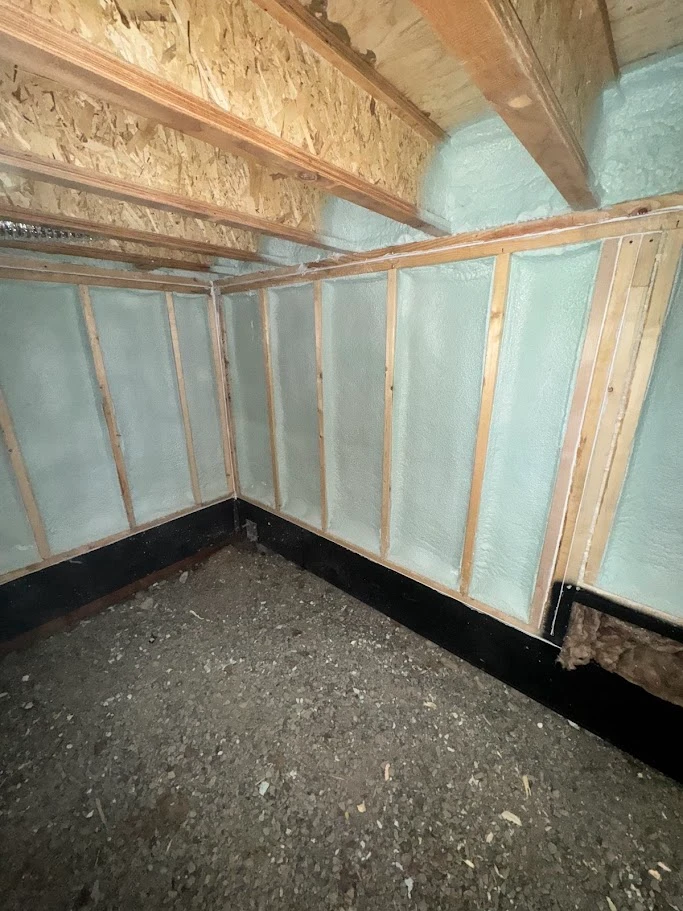
Spray foam insulation serves a range of purposes in Wasilla, AK homes and commercial buildings, from sealing attics and crawlspaces to insulating walls and basement rim joists. In a climate as demanding as Alaska’s Matanuska-Susitna Valley, where winter temperatures routinely plunge well below zero, reliable spray foam insulation is valued not just for its thermal resistance but for its ability to act as a simultaneous air barrier, moisture retarder, and structural reinforcement. The two primary types, open cell and closed cell, each serve different functions depending on the application, and choosing the right one depends on factors like the area being insulated, moisture exposure, and the specific R-value requirements for Alaska’s Climate Zone 7, where Wasilla falls under the state’s Building Energy Efficiency Standards.
Wasilla is located in the Matanuska-Susitna Borough, which the Alaska Housing Finance Corporation assigns to IECC Climate Zone 7, one of the coldest climate classifications in the United States. Homes in this zone face heating degree days ranging from 9,000 to 12,600 annually, meaning the heating season stretches for months and energy demands are substantial. The Alaska Building Energy Efficiency Standards (BEES), based on the 2018 IECC with Alaska-specific amendments, set some of the highest insulation requirements in the country for this zone.
According to the University of Alaska Fairbanks Cooperative Extension Service, Alaska buildings face challenges that go well beyond what Lower 48 construction accounts for. Floors above unconditioned spaces must maintain surface temperatures close to room ambient to prevent discomfort from cold air stratification. Rim joist areas require insulation equal to the wall or floor assembly they connect. Vapor barriers must be continuous and meticulously sealed around every penetration. Spray foam addresses several of these challenges at once by expanding to fill irregular cavities, adhering to framing members, and sealing the gaps that traditional batt insulation cannot reach.
Understanding the distinction between open cell and closed cell spray foam is the first step in matching the right product to the right application. The Spray Polyurethane Foam Alliance outlines three primary density categories, but for most residential and light commercial work in Wasilla, the choice comes down to open cell (low density) and closed cell (medium density).
Open cell spray foam is a low-density, semi-rigid foam with an R-value starting at approximately 3.6 per inch. Its open-cell structure makes it vapor permeable, meaning moisture can pass through it rather than getting trapped. This quality makes it suitable for interior applications where drying potential is needed.
Best uses in Wasilla homes:
Closed cell spray foam is a medium to high-density foam with an R-value starting at approximately 5.7 per inch. Its closed-cell structure gives it a higher resistance to heat flow and makes it function as a Class II vapor retarder, meaning it actively resists moisture transmission. It also adds structural rigidity to the assembly.
Best uses in Wasilla homes:
| Property | Open Cell Spray Foam | Closed Cell Spray Foam |
|---|---|---|
| Density | ~0.5 lbs./cu. ft. | ~2.0 lbs./cu. ft. |
| R-Value per Inch | ~3.6 | ~5.7 or higher |
| Air Barrier | Yes | Yes |
| Vapor Retarder | No (vapor permeable) | Yes (Class II) |
| Moisture Resistance | Low | High |
| Structural Reinforcement | Minimal | Moderate to high |
| Cost per Square Foot | Lower | Higher |
| Best Climate Fit | Interior, dry cavities | Moisture-prone areas, exteriors |
Attics are among the most common areas where Wasilla homeowners invest in spray foam. Heat rises, and in a climate where heating runs for the majority of the year, an under-insulated attic is a major source of energy loss. The Alaska BEES requires a minimum of R-54 (or R-43 with a properly sized energy-heel truss) for ceilings in Zone 7, which is difficult to achieve with fiberglass batts alone without deep truss cavities.
Spray foam can be applied directly to the roof deck in an unvented attic assembly, which brings the attic within the building’s conditioned envelope. This approach eliminates the need for attic ventilation and protects ductwork and mechanical systems from extreme cold. Closed cell foam is typically used for unvented attics because of its vapor retarder properties, while open cell can work in vented attics applied to the attic floor.
Crawlspaces in Alaska present a unique set of problems. Ground temperatures in Wasilla hover near 33 degrees Fahrenheit year-round, and moisture migration from soil is a persistent concern. The Alaska BEES amendments require crawl space walls to meet R-15 continuous or R-19 cavity insulation values in Climate Zone 7, and the space must not be vented to the outdoors when insulated.
Closed cell spray foam is the standard choice for crawlspace insulation in Wasilla. It seals the rim joist, insulates the foundation walls, and acts as a moisture barrier that prevents ground vapor from entering the living space. A Class I vapor retarder must also be placed over any exposed earth, but the foam itself handles the wall and joist sealing in a single application.
Wall insulation requirements in Zone 7 call for a minimum of R-25 in wood-frame walls. Spray foam can achieve this in a 2×6 cavity using closed cell product, eliminating the need for layered rigid foam sheathing. For retrofit situations where wall cavities are already closed, injection foam is sometimes used, but for new construction, spray-applied closed cell foam provides both the required R-value and an integrated air barrier.
Rim joist areas are particularly vulnerable in Alaska homes. These transition zones between the foundation and the first-floor framing are difficult to insulate with rigid boards or batts because of irregular shapes and numerous penetrations. Spray foam expands into every gap, sealing around plumbing and electrical lines that pass through the band joist.
Commercial insulation is a growing application for spray foam in Wasilla, AK. Metal buildings, warehouse facilities, and multi-unit residential structures benefit from spray foam’s ability to provide continuous insulation and an air barrier in a single step. A PNNL study prepared for the U.S. Department of Energy notes that effective air barrier systems in non-residential buildings can prevent a significant percentage of air leakage, leading to measurable reductions in heating costs in climate zones dominated by heating loads.
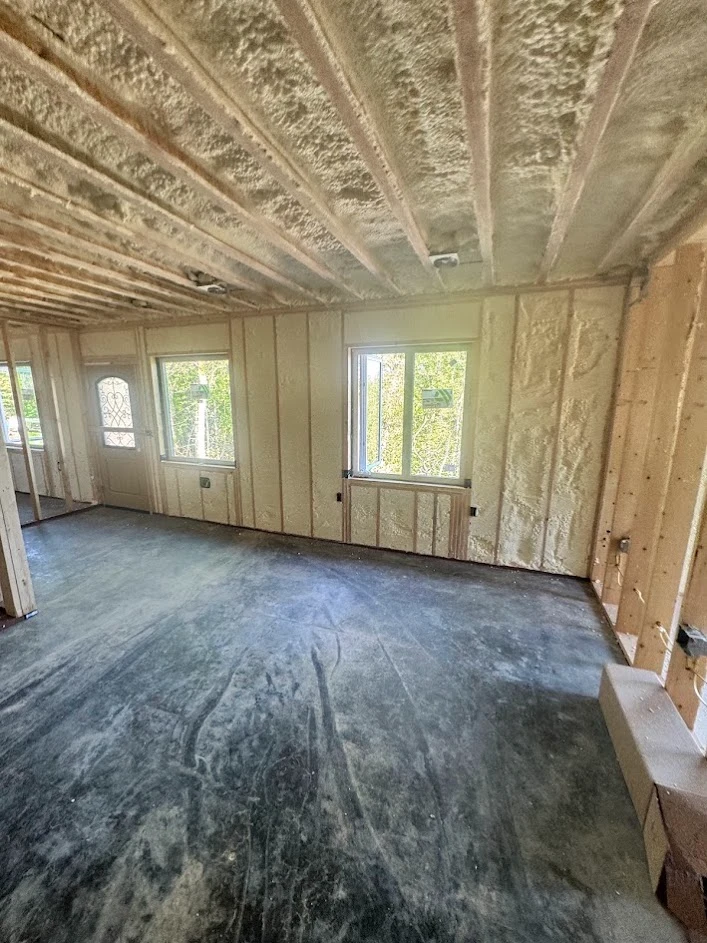
For commercial projects, closed cell spray foam is typically applied to walls, roofs, and around structural steel to create a monolithic insulation layer with no thermal bridging.
Below-grade foundation walls in Zone 7 require R-15 continuous insulation or R-19 cavity insulation per Alaska BEES. Spray foam applied to the interior of basement walls provides both the required thermal resistance and moisture control. The Alaska energy code explicitly allows spray foam meeting specific density requirements to serve in lieu of a traditional polyethylene vapor barrier in rim joist assemblies, simplifying construction details.
| Building Scenario | Recommended Foam Type | Key Application Areas | Why It Fits |
|---|---|---|---|
| New home construction | Closed cell or open cell combo | Walls, attic, rim joist, crawlspace | Meets BEES code, air seals during build |
| Existing home retrofit | Closed cell for crawlspaces; open cell for accessible attics | Crawlspace, attic floor, rim joist | Targets highest-loss areas without full gut renovation |
| Crawlspace encapsulation | Closed cell only | Walls, rim joist, floor rim | Vapor barrier needed against ground moisture |
| Metal building / commercial | Closed cell | Walls, roof deck, around structural steel | Continuous insulation, prevents condensation on metal |
| Unvented attic conversion | Closed cell | Roof deck, gable ends | Creates conditioned attic, protects ductwork from cold |
Choosing the right installer matters as much as choosing the right product. In Wasilla and the broader Mat-Su area, a few indicators separate qualified professionals from the rest.
Polyseal Insulation serves the Anchorage and Matanuska-Susitna Valley area with residential and commercial spray foam insulation services tailored to Alaska’s demanding climate conditions. Our team evaluates each project individually, accounting for building type, existing conditions, and the specific BEES requirements for Climate Zone 7 to recommend the right foam type and application for your property. Whether you need crawlspace encapsulation, attic insulation, wall cavity fills, or commercial building envelope solutions, we bring the experience and local knowledge that Alaska buildings demand.
Request a Quote | Schedule an On-Site Assessment
Reach us at [email protected] or call (907) 745-7325 to discuss your insulation needs with our team.
In a heating-dominated climate like Alaska’s Zone 7, the combination of high R-value per inch and air sealing in a single application makes spray foam one of the most effective ways to reduce heating costs and improve comfort year-round.
Yes, spray foam is commonly retrofitted in existing homes, especially in crawlspaces, attics, and rim joist areas where access allows. Some wall applications may require selective removal of finishes.
Closed cell spray foam qualifies as a Class II vapor retarder per the International Residential Code, and Alaska’s energy code allows it to serve in lieu of a traditional polyethylene vapor barrier in rim joist assemblies meeting specific density requirements.
Re-occupancy times depend on the product used, ventilation conditions, and application thickness. Your installer should provide specific guidance based on the manufacturer’s recommendations and NIST research on chemical emissions during curing.
Crawlspaces, attic assemblies, rim joists, and basement walls typically offer the highest return because these areas are the most difficult to seal with traditional insulation and are major sources of air and moisture infiltration.