
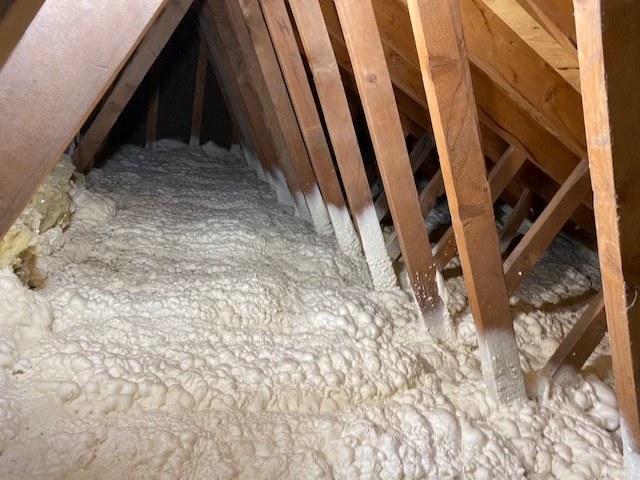
If you have ever lived in a home with drafty rooms, icicles forming along the roof edge, or heating bills that seem to climb every winter, you already understand why insulation matters. But not all insulation is created equal. Spray foam insulation has become one of the most talked-about options in building science over the past two decades, and for good reason. It offers a combination of air sealing, thermal resistance, and moisture control that traditional materials like fiberglass batts simply cannot match.
We have spent years installing spray foam insulation across homes and commercial buildings, and we have seen firsthand what works, what does not, and where homeowners tend to get confused. This guide is our way of putting all that experience into one place so you can make a confident, well-informed decision.
Spray foam insulation is a two-component chemical product, typically made from polyurethane, that is sprayed onto surfaces as a liquid and then expands into a solid foam. The two liquid components, an isocyanate (the “A side”) and a polyol resin blend (the “B side”), are kept in separate containers and heated before being pumped through a hose to a spray gun where they mix at the tip. The reaction between these chemicals causes the mixture to expand rapidly and harden into a continuous layer of foam insulation.
According to the U.S. Department of Energy’s Insulation Fact Sheet, spray foam insulation falls into a category of foam products that are “filled with special gases that provide additional resistance to heat flow,” which gives them higher R-values per inch than many other insulation materials. This chemical reaction is what sets spray foam apart from other insulation types. Instead of simply being laid into place like fiberglass batts or blown in like loose-fill cellulose, spray foam actively expands to fill gaps, cracks, and voids as it cures. That expansion is what gives spray foam its reputation as both an insulator and an air barrier.
There are two main categories of spray foam, and the distinction between them matters more than almost anything else in your decision. Let us break them down.
This is the single most common question we hear from homeowners. Understanding the differences will help you make the right choice for your specific project.
Open cell foam has a structure where the tiny cells within the foam are not completely closed. Think of it like a sponge, with lots of tiny interconnected pockets of air. This gives open cell foam some distinct properties:
Open cell foam is commonly used in interior walls, ceilings, and attic floor applications where moisture control is not a primary concern and where sound reduction is a benefit.
Closed cell spray foam has a structure where the cells are completely sealed, filled with a gas that gives it a higher resistance to heat flow. The cells are tightly packed together:
Closed cell foam is our most requested service and the one we recommend most often for the climate here in Alaska. The higher R-value per inch matters a great deal when temperatures drop well below freezing for extended periods, and the moisture resistance is critical in crawlspaces and basements where groundwater and condensation are constant concerns.
| Feature | Open Cell | Closed Cell |
|---|---|---|
| R-value per inch | 3.5 to 3.7 | 6.0 to 7.0 |
| Density (lb/cu ft) | ~0.5 | 1.7 to 2.0 |
| Vapor permeability | Vapor-permeable | Vapor retarder |
| Water resistance | Absorbs water | Resists water |
| Sound dampening | Excellent | Good |
| Structural rigidity | Low | High |
| Expansion ratio | Up to 100x | 30 to 40x |
| Typical thickness per pass | Thicker layer | Thinner layer |
Key Takeaways:
Expert Tip: If your wall cavities are shallow (like a standard 2×4 stud bay with only 3.5 inches of depth), closed cell foam may be your only practical option for reaching the R-value your climate zone demands. Open cell would need roughly twice the thickness to deliver the same thermal resistance.
Understanding how spray foam actually does its job helps explain why it outperforms traditional insulation in several key ways.
Heat flows naturally from warmer spaces to cooler spaces. In winter, the heat inside your home wants to escape to the cold outdoors. In summer, outdoor heat pushes into your air-conditioned interior. Insulation works by resisting that heat flow. The measurement of that resistance is called R-value. The higher the R-value, the better the insulation resists heat transfer.
Spray foam insulation achieves high R-values through two mechanisms. First, the solid plastic matrix of the foam itself is a poor conductor of heat. Second, the gas trapped within the closed cells (in closed cell foam) provides additional resistance. The Department of Energy explains that an insulating material’s resistance to conducting heat is measured by R-value, and the R-value depends on the type of insulation, its thickness, and its density.
For reference, here is how spray foam compares to other common insulation materials in terms of R-value per inch:
| Insulation Type | R-Value per Inch |
|---|---|
| Closed cell spray foam | 6.0 to 7.0 |
| Open cell spray foam | 3.5 to 3.7 |
| Extruded polystyrene (rigid board) | 5.0 to 6.5 |
| Fiberglass batt | 2.9 to 3.8 |
| Cellulose (loose fill) | 3.1 to 3.8 |
| Mineral wool batt | 3.3 to 4.2 |
This is where spray foam truly separates itself from the pack. Traditional insulation materials like fiberglass and cellulose do not stop air movement through the building envelope. They slow heat conduction through the wall or ceiling cavity, but air can still leak through gaps around the insulation, through electrical outlets, around plumbing penetrations, and along framing joints.
Spray foam, on the other hand, expands into every crack and crevice as it cures, creating a continuous air barrier. When installed properly, it seals the building envelope in a way that batt insulation simply cannot. This air sealing is arguably more important than the R-value itself, because uncontrolled air leakage accounts for a significant portion of energy loss in most homes. The Department of Energy has noted that heating and cooling account for 50 to 70% of the energy used in the average American home, and that inadequate insulation and air leakage are the leading causes of energy waste.
Moisture is one of the most destructive forces in any building. Condensation inside wall cavities can lead to mold growth, wood rot, and degraded insulation performance. Spray foam helps manage moisture in two ways. First, its air sealing properties prevent warm, moist indoor air from entering wall cavities and condensing on cold surfaces. Second, closed cell foam in particular acts as a vapor retarder, slowing the diffusion of water vapor through the building assembly.
In crawlspaces and basements, spray foam applied to the rim joist and foundation walls can prevent moisture from entering the living space and creating the damp conditions that encourage mold and mildew.
Not every area of a building calls for spray foam. Part of making a smart investment is knowing where it delivers the most value and where other insulation types might be a better fit.
Attics are one of the most common places homeowners lose energy. Heat rises, and an under-insulated attic allows that heat to escape through the roof. There are two primary approaches to insulating an attic with spray foam:
Attic floor insulation (traditional vented attic): Spray foam is applied to the attic floor, sealing around penetrations like electrical wires, plumbing vents, and recessed lights. This keeps the conditioned air below the insulation layer while allowing the attic space above to remain ventilated.
Cathedralized attic (unvented attic): Spray foam is applied directly to the underside of the roof deck, bringing the attic into the building’s conditioned envelope. This approach keeps ductwork and HVAC equipment inside the conditioned space, which can improve system efficiency significantly. According to the DOE fact sheet, up to 25% of heating and cooling energy can be wasted by leaky ductwork in a traditional vented attic. Bringing ducts inside conditioned space eliminates that waste.
Crawlspaces are often the most neglected part of a building envelope, yet they can be a major source of air infiltration, moisture problems, and energy loss. Spray foam applied to crawlspace walls and the floor joist above seals out humid air, prevents condensation, and keeps the floor above warmer. This is an area where closed cell foam is almost always the right call because of the moisture exposure.
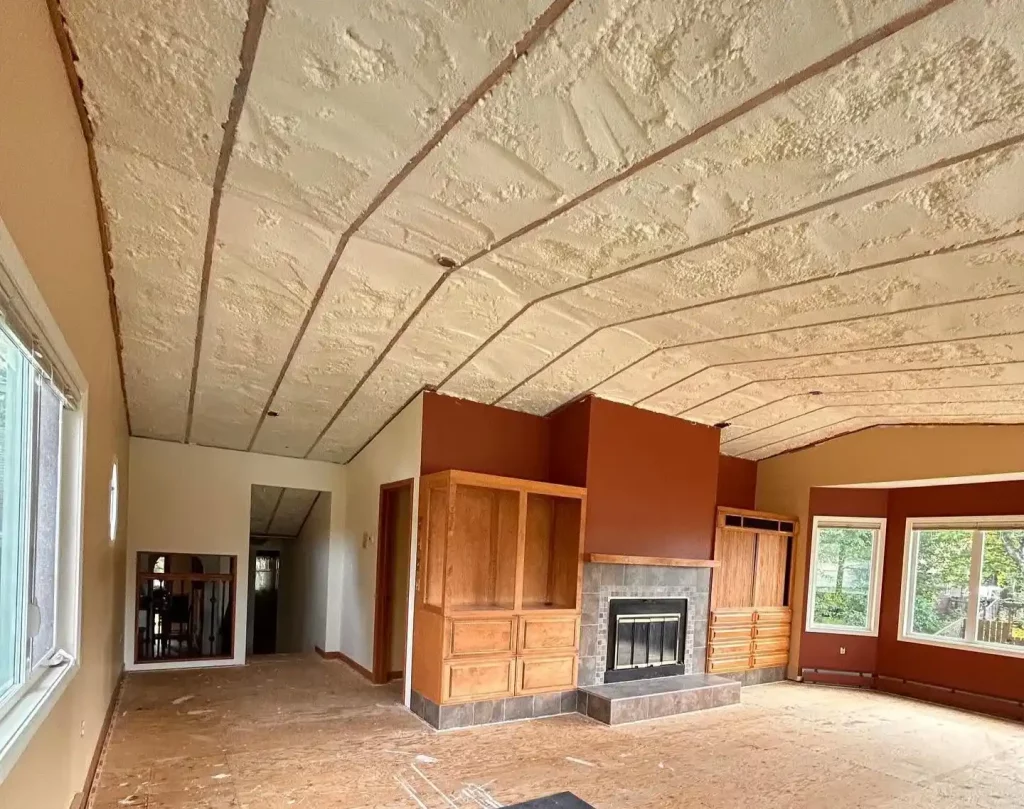
Expert Tip: Before insulating a crawlspace, make sure any standing water issues are resolved and the ground is covered with a continuous vapor retarder. Spray foam will not fix an active water intrusion problem, and trapping moisture behind foam can cause serious structural damage over time.
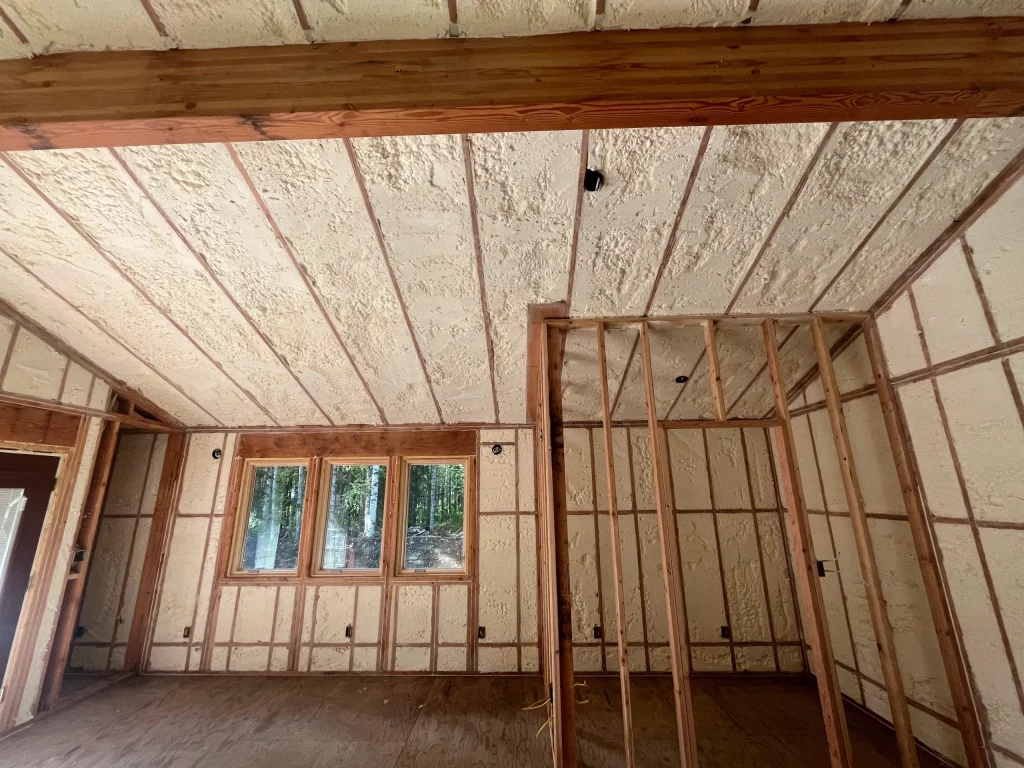
Spray foam in wall cavities delivers the best possible combination of R-value and air sealing. In new construction, spray foam can be applied directly to open stud bays before drywall goes up. In existing homes, it is possible to inject foam through small holes drilled into the wall cavity (though this is less common and less effective than open-cavity application).
For retrofit projects where walls are inaccessible, spray foam is often applied to the exterior as continuous insulation under new siding, or to the interior rim joist area where the floor framing meets the foundation. The Department of Energy specifically highlights that walls and rim joists make up more than 40% of the total envelope area of a house, making them a priority area for insulation and air sealing upgrades.
The rim joist (also called the band joist) is the area where the floor framing meets the exterior wall or foundation. This is notoriously one of the leakiest areas in any home because of the many gaps and penetrations around each joist bay. Spray foam is arguably the single best material for sealing rim joists. It expands into the irregular shapes and gaps that are nearly impossible to seal with fiberglass or rigid board insulation alone.
Understanding the installation process helps you prepare your home and set realistic expectations for the project timeline.
A thorough inspection of the area to be insulated is the first step. Our team evaluates the space, identifies potential problem areas like moisture issues, electrical wiring concerns, or structural damage, and determines the right type and thickness of foam for the application. In existing homes, we assess what needs to be removed (old insulation, vapor barriers, debris) before the new foam can be applied.
Spray foam application requires specialized equipment and trained professionals. Here is the general sequence:
Proper ventilation after installation is important. The foam continues to off-gas for a period after curing, and the building should be well-ventilated before occupants return. Re-occupancy timelines vary based on the specific product used, the thickness applied, and ventilation conditions. Our team provides specific guidance for each project.
Expert Tip: If you are having spray foam installed in an existing home, plan to be out of the house for at least 24 hours after the application is complete. Even after the foam has cured to the touch, volatile organic compounds can continue to off-gas. Open windows and run ventilation fans to speed the process along.
No honest guide to spray foam insulation would skip the safety conversation. Spray foam involves chemicals that demand respect during installation, and there are legitimate concerns that every homeowner should understand.
The two chemical components in spray foam, particularly the isocyanate on the A side, can cause respiratory irritation and skin sensitization if inhaled or contacted directly during application. Installers must wear full personal protective equipment (PPE), including respirators, protective suits, and gloves. This is one of the main reasons spray foam is not a do-it-yourself project. Professional installers are trained to handle these materials safely and have the proper ventilation equipment to protect themselves and the building occupants.
After application, spray foam goes through a curing process during which it releases volatile organic compounds (VOCs) and other gases. The level and duration of off-gassing depend on the specific formulation, the thickness of the application, and the ventilation conditions in the space. Most modern spray foam products have significantly reduced VOC content compared to formulations from a decade ago, but some odor and off-gassing should still be expected.
The primary concern for homeowners occurs when foam is improperly installed, over-applied, or installed in poorly ventilated spaces. In rare cases, homeowners have reported persistent chemical odors, respiratory irritation, and other health complaints after spray foam installation. These cases are most often linked to:
Key Takeaways:
Once spray foam has fully cured, which typically takes 24 to 72 hours depending on conditions, it is chemically inert. The finished foam does not off-gas or release fibers into the air. It does not support mold growth and does not degrade under normal conditions. For the vast majority of homeowners, properly installed and cured spray foam poses no ongoing health concerns.
Expert Tip: Always ask your installer what specific product they will be using and request the manufacturer’s technical data sheet (TDS) and safety data sheet (SDS). These documents provide detailed information about curing times, ventilation requirements, and any specific precautions for the product being applied.
After years of inspecting insulation projects, we have seen the same mistakes repeated. Here are the ones that cause the most problems:
Spray foam seals a space tightly. If you apply it to a damp or wet area, you may trap moisture inside the wall or ceiling assembly, leading to rot, mold, and structural damage. Always address water intrusion and moisture issues before insulating. This is especially critical in crawlspaces and basements.
Using open cell foam in a location that calls for closed cell (or vice versa) is a costly mistake. Applying open cell foam to a crawlspace wall in a damp climate, for example, allows moisture to pass through the foam and condense on cold surfaces behind it. Conversely, using closed cell foam where you need vapor permeability (like certain wall assemblies in mixed climates) can trap moisture inside the cavity.
Spray foam is expensive, and the temptation to save money by applying a thinner layer is real. But spray foam only delivers its advertised R-value at the specified thickness. A half-inch layer of closed cell foam rated at R-7 per inch only gives you R-3.5. Always verify that the installed thickness matches the specified R-value target for your climate zone.
Even the best spray foam installation will underperform if other areas of the building envelope are left unsealed. Before or during your insulation project, make sure other common air leak locations, such as around windows and doors, plumbing penetrations, and electrical boxes, are also sealed.
When spray foam significantly reduces air leakage through the building envelope, you may need to add mechanical ventilation to maintain indoor air quality. Homes that were previously “leaky enough” may become too tight after spray foam installation, leading to stale air, humidity buildup, and potential indoor air quality issues. Discuss ventilation strategies with your installer.
The financial case for spray foam insulation comes down to two things: reduced energy bills and increased comfort.
According to the Department of Energy, heating and cooling account for 50 to 70% of the energy used in the average American home, and inadequate insulation and air leakage are the leading causes of energy waste. By dramatically reducing both conductive heat loss and air infiltration, spray foam can have a meaningful impact on those energy costs.
Exactly how much you save depends on your climate, the size and construction of your home, your existing insulation levels, your heating fuel type, and your thermostat settings. Homes in extreme cold climates tend to see the greatest percentage savings because the temperature difference between indoors and outdoors is so large.
Beyond monthly energy bills, spray foam insulation offers less obvious but still real financial benefits:
The federal government offers tax credits that can offset the cost of spray foam insulation. The Department of Energy has detailed information on the Energy-Efficient Home Improvement Credit, which covers insulation and air-sealing improvements that meet the 2021 International Energy Conservation Code (IECC). This credit applies to both existing homes and new construction, making it a valuable incentive for homeowners considering spray foam.
The credit is available for insulation material and air-sealing products, as well as the labor costs associated with their installation. To qualify, the improvements must meet specific requirements outlined in the IECC. Always consult a tax professional to understand how these credits apply to your specific situation.
Expert Tip: Keep detailed records of your insulation project, including product labels, manufacturer specifications, installation invoices, and photographs. These documents are often required to claim the tax credit and can also be valuable if you ever sell the home.
The spray foam insulation industry is growing steadily, driven by rising energy costs, stricter building codes, and increased awareness of energy efficiency. According to a market analysis published by Walls & Ceilings, the global spray foam insulation market was valued at approximately $2.97 billion in 2024 and is expected to reach $4.12 billion by 2031, growing at a compound annual growth rate of 4.8%.
Several key trends are shaping the direction of the industry:
For homeowners in cold climates like ours, these trends are particularly relevant. The push for higher R-values in exterior walls and roofs means that spray foam’s ability to deliver high thermal resistance in limited cavity depths will only become more valuable as codes tighten.
Spray foam insulation is not the right answer for every project, but when applied correctly and in the right locations, it delivers a combination of thermal performance, air sealing, and moisture control that is hard to match with any other single product. At Polyseal Insulation, we help property owners make informed decisions about which type of foam to use, where to apply it, and how to prepare the space properly before installation to achieve the best long-term results.
Take the time to evaluate your building’s specific needs. Consider your climate zone, your existing insulation levels, any moisture issues, and your budget. Work with experienced professionals who can assess your home and recommend the right approach. Keep records of your project for tax credit purposes and future reference.
This guide is here whenever you need to reference it. Whether you are planning a new construction project, upgrading an existing home, or simply trying to understand why your energy bills are higher than they should be, the fundamentals covered here apply.
If you are considering spray foam insulation for your home or commercial building and want to talk through your options with an experienced team, we are here to help. You can reach Polyseal Insulation at [email protected] or give us a call at (907) 745-7325. We serve the Anchorage and Matanuska-Susitna Valley area and would be happy to assess your project.
When properly installed, spray foam insulation lasts the lifetime of the building. It does not settle, sag, or degrade over time like some other insulation materials. The foam is chemically inert once fully cured and does not break down under normal conditions.
Yes, spray foam can be installed in cold weather, but it requires specific precautions. Both the substrate (the surface being sprayed) and the chemical components must be kept within the manufacturer’s recommended temperature range for the foam to expand and cure properly. Professional installers use heated equipment and temporary climate control measures to ensure proper application even in cold conditions.
Spray foam applied over electrical wiring or plumbing is generally safe once cured. However, the foam should not be applied directly over knob and tube wiring, which is common in homes built before the 1940s. The National Electric Code prohibits installing foam insulation around knob and tube wiring because it can cause the wires to overheat.
Spray foam insulation is combustible and must be covered with a thermal barrier, such as drywall or an intumescent coating, in occupied spaces. Building codes require this thermal barrier to protect the foam from direct exposure to fire. The specific requirements vary by application and local code.
Spray foam installation is not a do-it-yourself project. The chemicals involved require specialized equipment, precise metering, proper PPE, and training to handle safely. Improper mixing, incorrect application temperatures, or inadequate ventilation during installation can result in poor curing, persistent odors, and potential health risks.
Spray foam insulation typically has a higher upfront material and labor cost per square foot compared to fiberglass batts. However, spray foam delivers air sealing along with insulation in a single step, potentially reducing the need for separate air sealing work. The long-term energy savings, moisture control benefits, and durability of spray foam are factors that offset the higher initial investment over time.