
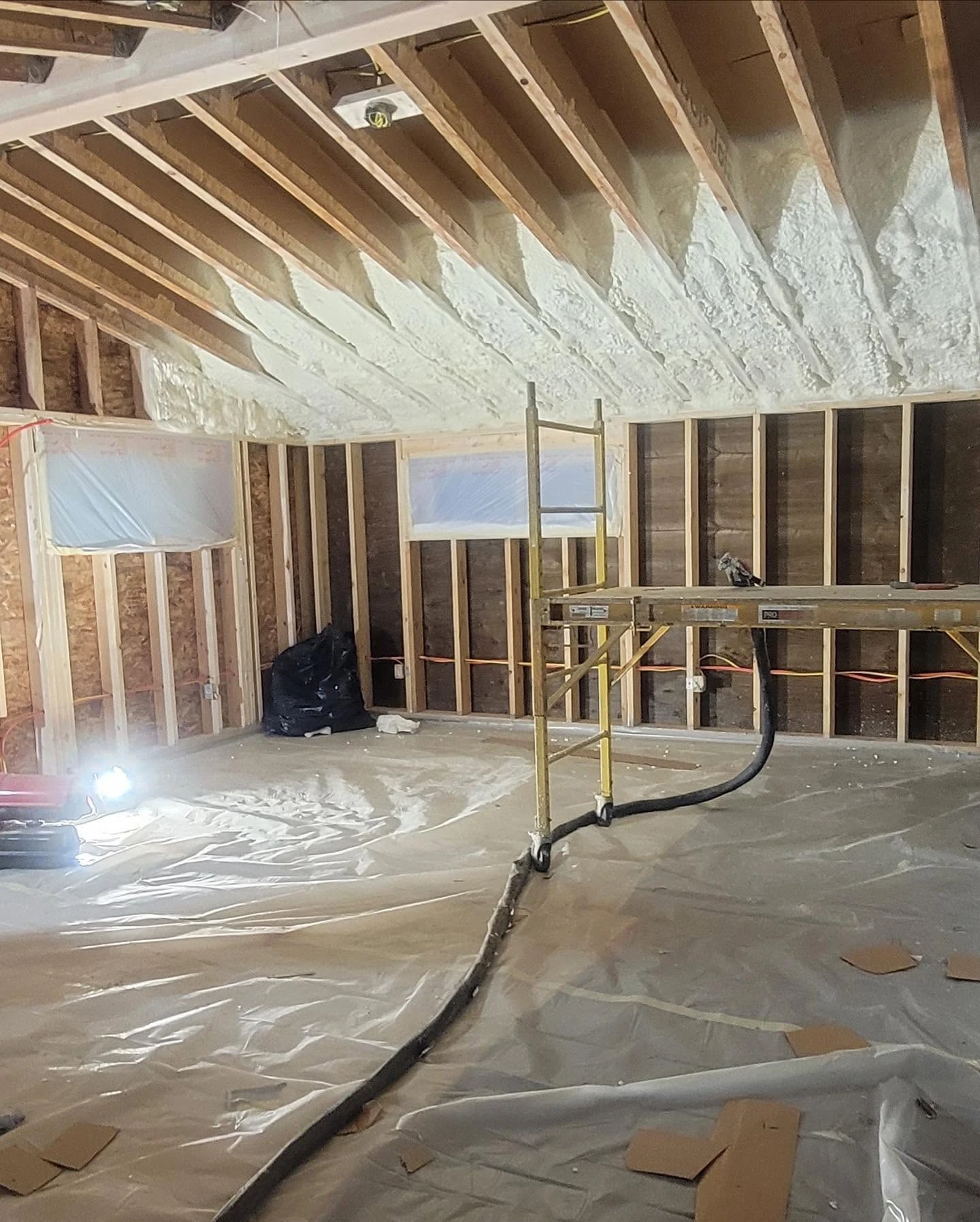
Open-cell spray foam insulation delivers strong air sealing and sound control in Butte, AK, but its suitability depends heavily on where it is installed and how it is paired with other materials. In this IECC Climate Zone 7 community, where winter lows average 9°F and 28 days per year drop below zero, The Essential Guide to Open-Cell Spray Foam for Every Building helps explain why open-cell spray foam can work well in above-grade wall cavities when paired with an interior vapor retarder. However, building science research shows it should not be used alone in unvented attics, below-grade foundations, or crawlspaces in this climate zone. The right approach depends on the specific assembly, the season, and the moisture control strategy behind it.
Butte sits in the Matanuska-Susitna Borough at roughly 98 feet elevation, experiencing long, cold winters and short, mild summers. January lows average 9°F with nearly 28 days each year dipping below zero. July highs reach about 67°F. The area receives roughly 14 inches of rain and 48 inches of snow annually, with relatively low humidity year-round.
According to the DOE Building America climate guide, Matanuska-Susitna Borough is classified as IECC Climate Zone 7 (“Very Cold”), with 9,000 to 12,600 heating degrees. The University of Alaska Fairbanks Cooperative Extension building manual places this region in Southcentral Alaska (Region 2) and prescribes minimum R-values of R-38 for ceilings, R-25 for above-grade walls, and R-30 for floors over unconditioned space.
This combination of extreme cold, large indoor-to-outdoor temperature differentials, and the resulting moisture drive makes material selection and vapor management especially important.
Open-cell spray foam services is a low-density material (approximately 0.5 lb per cubic foot) that expands roughly 150 times its liquid volume during application. Key properties for Butte homeowners to understand:
| Property | Open-Cell Spray Foam | Closed-Cell Spray Foam |
|---|---|---|
| R-value per inch | ~R-3.6 | ~R-6.1 |
| Vapor permeance at typical depth | ~10 perms at 5″ (vapor-permeable) | Less than 1 perm at 2″ (vapor retarder) |
| Air permeance | Air-impermeable | Air-impermeable |
| Water absorption | Absorbs and holds liquid water | Hydrophobic, does not absorb water |
| Density | ~0.5 lb/cu ft | ~2.0 lb/cu ft |
| Compressive strength | Less than 2 psi | ~22 psi |
The DOE Building America spray foam guide notes that open-cell foam at a typical 5-inch thickness rates between 5 and 10 perms, well above the 1.0 perm threshold that defines a vapor retarder. This is the single most important property to understand when evaluating open-cell foam for a Zone 7 home.
Winter is where insulation either proves its value or creates problems. With indoor temperatures around 68°F and outdoor temperatures routinely dropping to single digits, the temperature differential across the building envelope can exceed 60°F. This drives interior moisture vapor outward through any vapor-permeable material.
Open-cell spray foam in wall cavities blocks air infiltration effectively, which is its primary winter benefit. The air sealing alone reduces convective heat loss significantly. However, because the foam is vapor-permeable, interior moisture can diffuse through it and reach the exterior sheathing. In a Zone 7 winter, that sheathing is cold enough for condensation to occur.
The Building Science Corporation residential spray foam guide states that in IECC Climate Zones 6 and higher, closed-cell spray foam provides condensation control and qualifies as a Class II vapor retarder at 1.5 inches thickness. Open-cell foam can work in walls in these zones but requires an interior vapor retarder, typically a vapor-retarder paint applied to the gypsum board.
Spring in Butte brings warming temperatures but also the thaw cycle. Snowmelt around foundations increases groundwater contact with below-grade walls. This is when the water-absorption risk of open-cell foam becomes relevant. Open-cell foam can hold up to one-third of its volume in water, and saturated foam loses thermal performance. This is why the DOE guide rates open-cell foam as “not acceptable” for below-grade and foundation applications in any climate.
Summer is the least demanding season for insulation in Butte, with July highs around 67°F. The temperature differential across the envelope is small, so thermal performance is less stressed. Open-cell foam’s sound-attenuating properties are noticeable during summer months when windows may be open and outdoor noise is more present.
The low outdoor humidity during Butte summers means less exterior moisture drive, which reduces risk for wall assemblies. However, any open-cell foam installed in an unvented attic assembly could still face issues from interior moisture sources if the space is not properly conditioned and ventilated.
Fall brings dropping temperatures and increasing precipitation. This transition season is when condensation risk begins to climb as the exterior sheathing cools while indoor humidity remains elevated from daily activities. Wall assemblies with open-cell foam need that interior vapor retarder to be fully intact before the heating season begins.
This is the most appropriate application for open-cell spray foam in Climate Zone 7. When installed in a 2×6 wall cavity (5.5 inches), open-cell foam delivers approximately R-20. To meet the Alaska Building Energy Efficiency Standard’s R-25 wall requirement for Southcentral Alaska, additional insulation such as rigid foam on the exterior sheathing may be needed.
The assembly must include an interior vapor retarder, typically vapor-retarder primer or acrylic latex paint on the gypsum board, and the exterior sheathing must remain vapor-permeable (greater than 5 perms) to allow any accumulated moisture to dry outward.
The Building Science Corporation BSI-116 guide describes hybrid walls where a layer of closed-cell foam is sprayed against the interior side of the exterior sheathing, with open-cell foam filling the remaining cavity depth. In Zone 7, the IRC requires enough closed-cell foam to prevent condensation on its interior surface. This approach gives you the vapor control of closed-cell at the sheathing plane and the cost efficiency of open-cell filling the rest of the cavity.
Building Science Corporation explicitly states that in IECC Climate Zones 5 and higher, only high-density closed-cell spray foam should be used for unvented conditioned attics. Applying vapor-retarder paint to the surface of open-cell foam has shown only “limited success” in controlling moisture migration to the cold roof deck.
Open-cell foam’s water absorption makes it incompatible with below-grade applications where moisture exposure is likely. The DOE guide classifies this application as “not acceptable” for open-cell foam.
Only closed-cell spray foam should be used in vented crawlspace floor framing in all IECC climate zones, per BSC guidance.
| Application in Butte | Open-Cell Foam Verdict | Key Requirement |
|---|---|---|
| Above-grade walls | Acceptable with conditions | Interior vapor retarder paint required |
| Hybrid walls (ccSPF + ocSPF) | Good option | Follow IRC Table R702.7 for ccSPF thickness |
| Unvented attics | Not recommended | Use closed-cell only in Zone 7 |
| Vented attic ceiling air seal | Acceptable | Pair with blown-in insulation above |
| Below-grade / foundations | Not acceptable | Use closed-cell only |
| Vented crawlspace floor framing | Not acceptable | Use closed-cell only |
| Band joists / rim joists | Acceptable (with caution) | Closed-cell preferred in extreme cold |
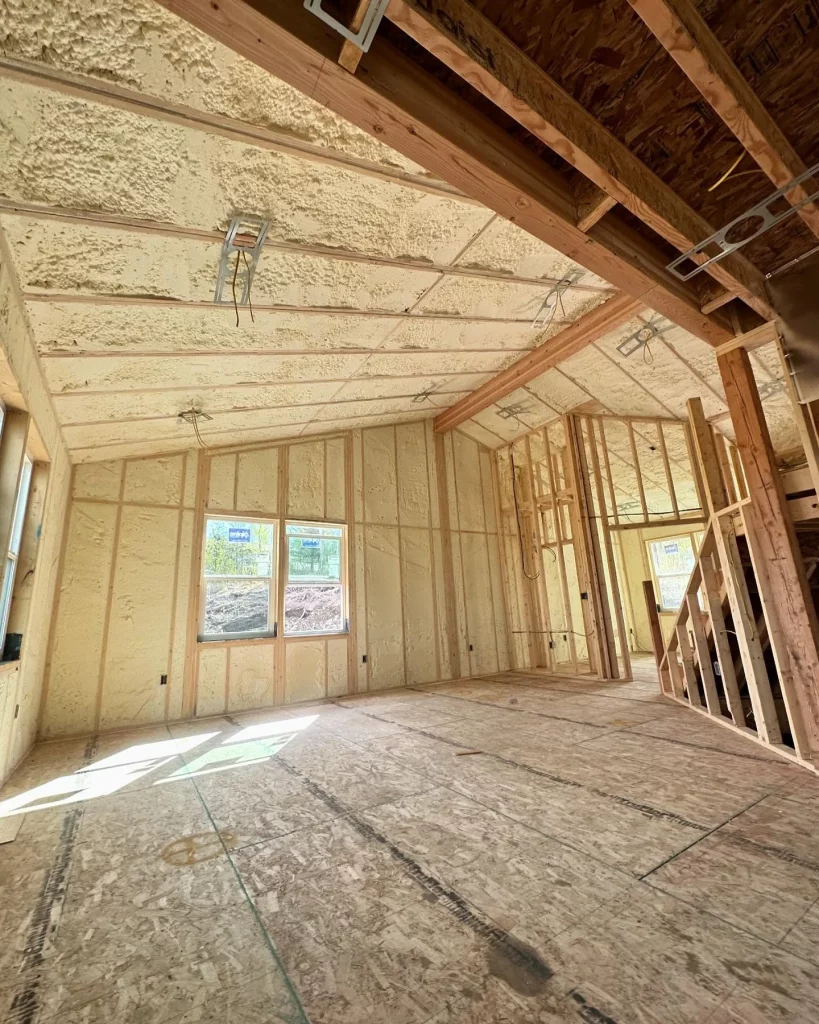
A proper assessment for open-cell spray foam in Butte, AK, Climate Zone 7 should include a clear explanation of where the foam will and will not be installed, a specific plan for vapor control at interior surfaces, and a realistic R-value calculation that accounts for the foam’s R-3.6 per inch. Our team evaluates each assembly individually rather than applying a one-size-fits-all approach. We account for the specific heating system, ventilation strategy, and occupancy patterns of the home, because mechanical ventilation and humidity control are not optional in a well-insulated Zone 7 house. We also confirm that the exterior sheathing allows outward drying and that no vapor-impermeable layer on the exterior will trap moisture inside the cavity.
Polyseal Insulation has been serving the Anchorage and Matanuska Valley area (99508) with spray foam insulation for homes between 1,500 and 4,000 square feet. Our team understands the specific demands of Climate Zone 7 and knows where open-cell spray foam adds value and where closed-cell is the safer, code-compliant choice. We assess every project individually, factoring in access difficulty, existing conditions, and the specific assembly details that determine long-term performance.
Request a Quote | Schedule an Insulation Assessment
Reach us at [email protected] or call (907) 745-7325 to discuss your project.
In a standard 2×6 cavity (5.5 inches), open-cell foam delivers approximately R-20, which falls short of the R-25 minimum for Southcentral Alaska. You would need an additional exterior insulation layer or a hybrid assembly to meet code.
Open-cell foam can absorb and hold up to one-third of its volume in water, which reduces its R-value and can lead to sheathing rot if the moisture has no drying path. This is why an interior vapor retarder and vapor-permeable exterior are both required in Zone 7.
Open-cell costs less per R-value than closed-cell and provides better sound attenuation. It can be the right choice for above-grade wall cavities when paired with proper vapor control, but closed-cell is preferred or required for attics, foundations, and crawlspaces in this climate.
In Climate Zone 7, interior moisture will diffuse through vapor-permeable open-cell foam and condense on the cold roof sheathing, which can lead to wood rot. Vapor-retarder paint on open-cell foam has shown only limited success in preventing this.
The mild, relatively dry summers do provide a drying season for wall assemblies, but the drying potential depends on the exterior sheathing being vapor-permeable. If the exterior cladding or sheathing blocks outward drying, moisture accumulated during winter may not fully dissipate.