
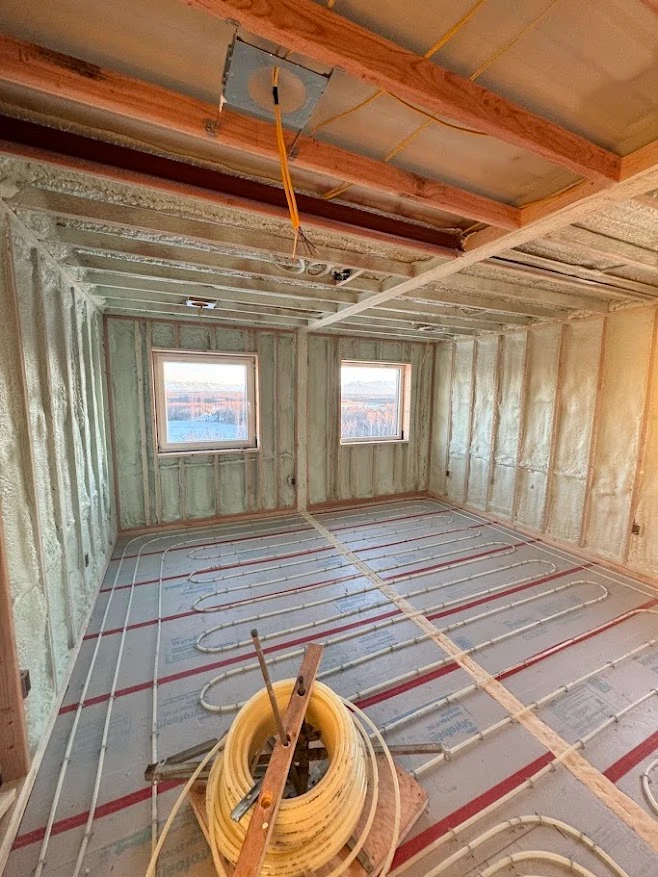
Closed-cell spray foam insulation is the preferred choice for buildings in Butte, AK because it delivers the highest R-value per inch of any common insulation material, acts as a vapor retarder and air barrier in a single application, and resists moisture absorption in a climate where winter temperatures regularly drop well below zero. Butte sits in the Matanuska-Susitna Borough, which the Alaska Housing Finance Corporation (AHFC) classifies as Climate Zone 7, a region with 9,000 to 12,600 heating degree days per year. In zones this cold, the Closed-Cell Spray Foam Comprehensive Guide highlights why the margin for error on insulation performance is thin, and materials that combine high thermal resistance with moisture control and air sealing offer the most reliable protection against heat loss, condensation, and structural damage. The right insulation choice depends on factors like building type, budget, and whether the project is new construction or a retrofit, but closed-cell spray foam consistently outperforms alternatives in extreme cold when all factors are weighed together.
The Matanuska-Susitna Borough, including Butte, is assigned to Climate Zone 7 under the IECC Compliance Guide for Homes in Alaska. This zone encompasses areas with 9,000 to 12,600 heating degree days annually. For comparison, the 2021 IECC requires Zone 7 and 8 buildings to meet R-60 for uninsulated attics and R-20 cavity insulation plus R-5 continuous insulation for wood-frame walls. The AHFC’s own Alaska Building Energy Efficiency Standards (BEES) push even higher, requiring R-43 to R-54 for ceilings and R-25 for wood-frame walls in Zone 7.
These are not suggestions. Homes financed through AHFC must demonstrate compliance with these standards, and the thermal envelope requirements directly affect which insulation materials are practical. In a 2×4 wall cavity measuring just 3.5 inches, achieving R-20 with fiberglass (R-3.2 per inch) would require over 6 inches, which is physically impossible. Closed-cell spray foam at R-6 to R-6.5 per inch can reach R-21 in a 3-inch application, making it one of the few materials that can meet Zone 7 wall requirements within standard framing depths.
The DOE Building America research team evaluated both open-cell and closed-cell spray polyurethane foam across multiple climate zones and applications. Their findings are clear: closed-cell spray foam is rated as “preferred” for cold-climate frame wall cavities, sloped roof rafters, foundations, band joists, and cantilevered framing. Open-cell is “preferred” for some cold-climate wall applications but “not acceptable” for foundations and below-grade spaces.
Several physical properties explain this preference:
| Property | Closed-Cell Spray Foam | Open-Cell Spray Foam |
|---|---|---|
| R-Value per inch | R-6.0 to R-6.5 | R-3.5 to R-3.8 |
| Density | ~2.0 lb/cu ft | ~0.5 lb/cu ft |
| Vapor permeance at typical thickness | Less than 1.0 perm (vapor retarder) | 5 to 10 perms (vapor permeable) |
| Water absorption | Hydrophobic, does not absorb water | Can absorb up to 1/3 volume in water |
| Compressive strength | ~22 psi | Less than 2 psi |
| Air permeance | Air-impermeable | Air-impermeable |
| Best cold-climate rating (DOE) | Preferred in all envelope applications | Preferred in walls only; not acceptable below grade |
In Climate Zone 7, the temperature difference between indoor heated spaces and the outdoor environment can exceed 100 degrees Fahrenheit during winter. That extreme delta-T creates a strong vapor drive from the warm interior toward the cold exterior. If moisture from daily activities like cooking, showering, and breathing enters wall or ceiling assemblies and reaches a surface below the dew point, condensation forms. Over time, this leads to mold growth, wood rot, and compromised structural integrity.
Closed-cell spray foam addresses this in two ways. First, closed-cell high-performance insulation is air-impermeable, sealing the gaps, cracks, and penetrations through which the vast majority of moisture moves. According to building science research, roughly 99% of moisture problems in walls and roofs result from air leakage, not vapor diffusion. Second, at thicknesses of 1.5 inches or more, closed-cell foam achieves a perm rating below 1.0, functioning as a vapor retarder. This means it blocks vapor diffusion as well, eliminating the need for a separate polyethylene vapor barrier.
Open-cell spray foam, by contrast, allows vapor to pass through freely and can absorb and hold significant amounts of liquid water. In a below-grade crawlspace or against a foundation wall, this makes open-cell foam unsuitable. The DOE guide specifically rates open-cell foam as “not acceptable” for foundations and below-grade spaces.
Air leakage is one of the largest sources of energy waste in residential and commercial buildings. The AHFC BEES amendments require buildings to demonstrate no more than 4 air changes per hour at 50 Pascals pressure in Climate Zones 3 through 8. Spray polyurethane foam of both types excels at air sealing because the liquid-to-expanding-foam application process fills gaps, cracks, and voids that batt insulation cannot reach.
The DOE’s guide to home insulation notes that homeowners can save up to 20% on heating and cooling costs by adding insulation to attics, floors, crawlspaces, and accessible basement rim joists, combined with reducing unwanted air leaks. In a heating-dominated climate like Butte, where heating costs represent the largest portion of annual energy bills, that 20% savings is substantial.
Closed-cell spray foam does more than insulate. The material bonds directly to wood, metal, and concrete substrates, forming a rigid layer that adds structural strength to the assembly. Research cited in the DOE Building America guide found that closed-cell foam substantially increases the racking strength of frame walls, an advantage in both seismic and high-wind zones. The foam’s compressive strength of approximately 22 psi also means it resists damage from handling, settling, and environmental exposure over time.
For buildings in the Matanuska Valley, where freeze-thaw cycles, heavy snow loads, and seasonal ground movement are constant concerns, this added rigidity and adhesion helps maintain the integrity of the building envelope year after year.
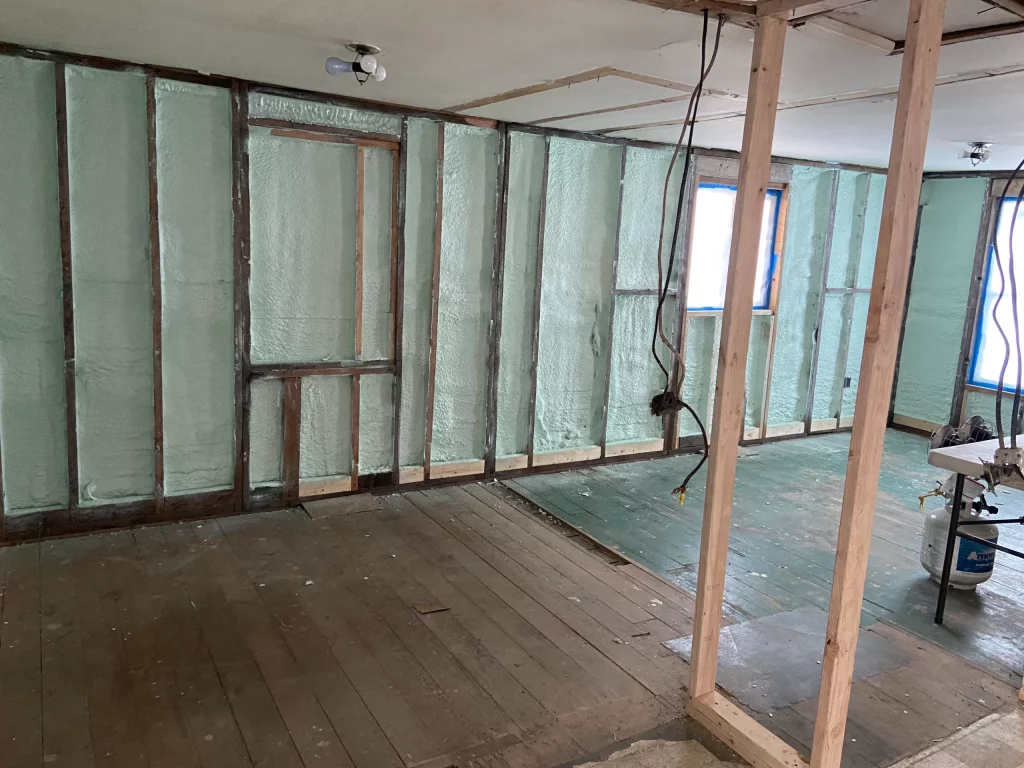
Not every building assembly needs closed-cell spray foam. Budget constraints and practical considerations often lead to hybrid approaches. The DOE guide supports a “flash-and-batt” method where a thin layer of closed-cell foam is applied to the interior face of exterior sheathing for air sealing and vapor control, then the remaining cavity is filled with fiberglass batt or blown-in insulation. This approach reduces material costs while maintaining the moisture and air barrier benefits.
| Building Assembly | Recommended Insulation Strategy | Why |
|---|---|---|
| Foundation walls and below-grade | Closed-cell spray foam only | Moisture resistance and vapor retarder required; open-cell is not acceptable |
| Crawlspace walls and rim joists | Closed-cell spray foam | Hydrophobic properties prevent water absorption in flood-prone areas |
| Frame wall cavities | Closed-cell full-fill or flash-and-batt | High R-value per inch meets code; vapor retarder eliminates need for separate barrier |
| Sloped roof rafters / cathedral ceilings | Closed-cell spray foam | Achieves high R-values in limited rafter depth; preferred for all climates per DOE |
| Attic floor (vented attic) | Closed-cell air seal layer + blown-in insulation | Air sealing at penetration points, with cost-effective blown insulation above |
When evaluating insulation options for a building in Butte, watch for these indicators that the recommended approach is sound:
Polyseal Insulation serves the Anchorage and Matanuska Valley area, including Butte, with closed-cell spray foam insulation for residential and commercial buildings. Our team evaluates each project against Alaska’s Climate Zone 7 requirements and recommends the right approach for your building’s specific assemblies, whether that is full closed-cell application, flash-and-batt hybrid, or targeted crawlspace and rim joist insulation.
Request a quote for your project or schedule a consultation to discuss which insulation strategy fits your building and budget.
Request a Quote | Schedule a Consultation
Reach us at [email protected] or call (907) 745-7325 to get started.
Closed-cell spray foam delivers approximately R-6 to R-6.5 per inch, making it one of the highest R-value insulation materials available for standard cavity depths.
At thicknesses of 1.5 inches or more, closed-cell spray foam achieves a perm rating below 1.0, qualifying as a Class I vapor retarder without needing a separate polyethylene sheet.
The DOE Building America guide rates open-cell foam as “not acceptable” for below-grade and foundation applications due to water absorption, making closed-cell the appropriate choice for crawlspace insulation in this climate.
The DOE estimates that proper insulation combined with air sealing can reduce heating and cooling costs by up to 20%, which is especially meaningful in heating-dominated climates with extreme winter temperatures.
Fiberglass offers roughly R-3.2 per inch and provides no air sealing or moisture resistance. Closed-cell spray foam at R-6+ per inch delivers nearly twice the thermal performance per inch while also serving as an air barrier and vapor retarder.