
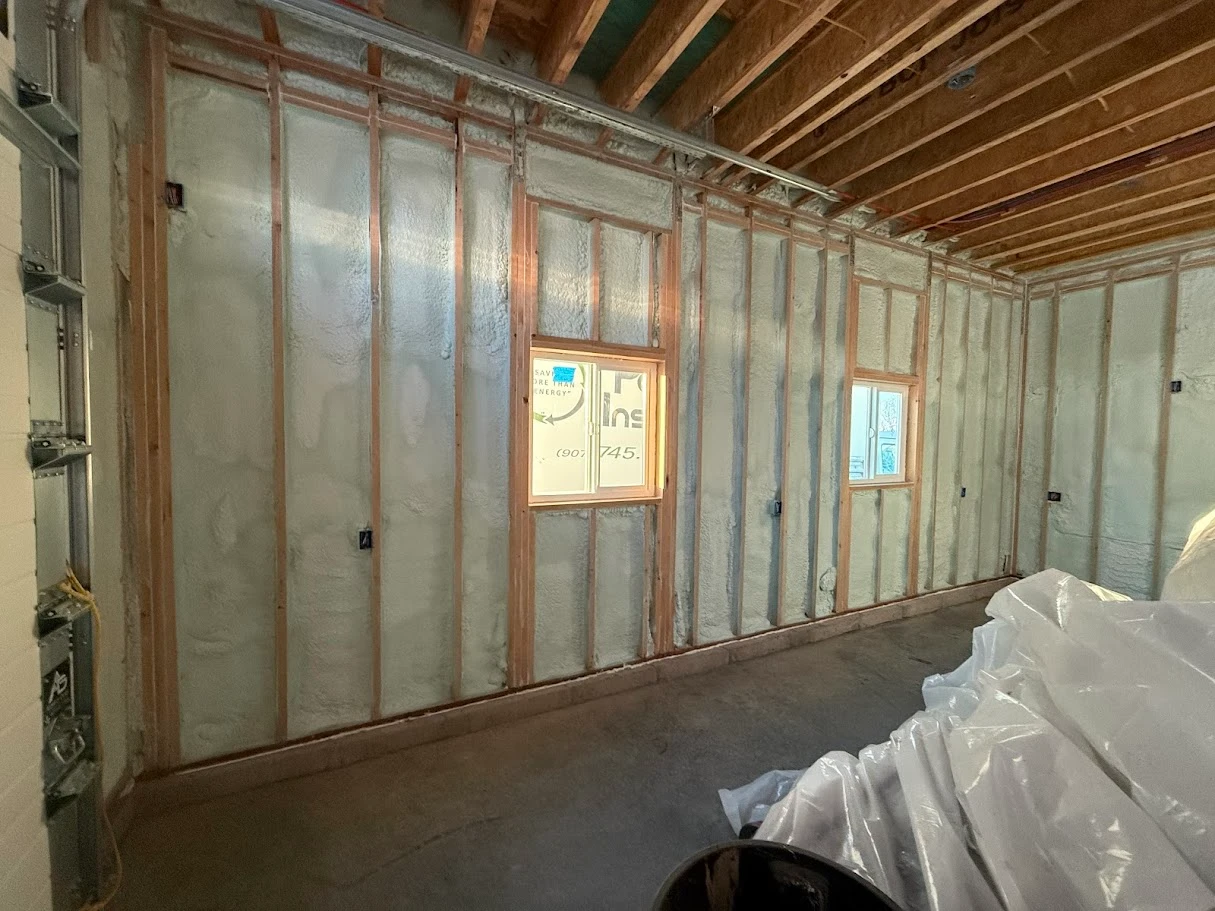
Closed-cell spray foam delivers a combination of high thermal resistance, air sealing, moisture control, and structural reinforcement that few other insulation materials can match in a single application. For homeowners and builders in cold climates like Alaska, where insulation decisions directly affect comfort, energy bills, and structural longevity, understanding closed-cell spray foam helps explain why this material stands out as a solution that handles water, air, vapor, and heat control simultaneously.The right insulation choice depends on climate zone, project scope, budget, and whether the priority is thermal performance, moisture management, or a balance of both. Understanding what sets closed-cell foam apart, where it performs best, and how to evaluate quality installation helps ensure you invest wisely.
Spray polyurethane foam insulation is created by mixing two chemical components, isocyanate (Side A) and polyol resin (Side B), at the tip of a spray gun. The reaction causes the mixture to expand and cure into a rigid cellular plastic that adheres directly to the substrate. According to the U.S. Environmental Protection Agency, this exothermic reaction produces a foam with millions of tiny closed cells filled with low-conductivity gas, which gives the material its high thermal resistance.
Closed-cell foam differs from open-cell foam in its cell structure. Each cell in closed-cell foam has a solid, unbroken wall, like a tightly packed array of tiny inflated balloons. This structure gives the foam its rigidity, higher density (approximately 2 pounds per cubic foot), and superior resistance to heat, air, and moisture transfer. As described on Wikipedia’s spray foam reference, medium-density closed-cell spray foam achieves a Long Term Thermal Resistance (LTTR) R-value between R-5.1 and R-6 per inch, while open-cell foam typically delivers around R-3.8 per inch. For a given cavity depth, that means closed-cell foam provides roughly 50 to 60 percent more thermal resistance.
This density also means closed-cell foam acts as an air barrier and, at sufficient thickness, a vapor retarder. Traditional insulation materials like fiberglass or cellulose rely on separate air sealing measures, such as caulking and weatherstripping, to close gaps. Closed-cell foam seals as it insulates, filling cracks, crevices, and irregular surfaces in a single pass.
The U.S. Department of Energy’s Guide to Home Insulation lists closed-cell polyurethane spray foam at R-6.5 per inch for a 1-inch application. This per-inch performance far exceeds fiberglass batts (R-3.0 to R-3.8 per inch) and cellulose loose fill, which means closed-cell foam achieves target R-values in less cavity depth. In new construction where wall thickness is limited, this higher per-inch value allows builders to meet or exceed code requirements without deeper framing.
The DOE notes that up to 40% of a home’s energy is lost through air infiltration through walls, windows, and doorways. Closed-cell spray foam forms a monolithic, continuous layer that blocks convective heat transfer by eliminating air movement through the building envelope. Unlike batt insulation, which can leave gaps around framing, wiring, and plumbing penetrations, spray foam expands into every void and adheres to the substrate, creating an airtight seal.
According to the Building Science Corporation’s Residential Spray Foam Guide, spray foam insulation offers significant advantages because of its ability to provide continuity of water control, air control, vapor control, and thermal control layers. In IECC Climate Zones 5 through 8, high-density closed-cell spray foam provides additional condensation control and qualifies as a Class II vapor retarder at 1.5 inches of thickness. This eliminates the need to install a separate polyethylene vapor barrier on the warm-in-winter side of the assembly.
For crawlspaces and basements, where moisture infiltration from soil is a constant concern, closed-cell foam’s resistance to water absorption makes it the preferred choice. Building Science Corporation recommends only high-density closed-cell spray foam for vented crawlspace floor framing in all climate zones, and for unvented conditioned attics in Climate Zones 5 and higher.
The rigid, dense nature of closed-cell foam adds structural integrity to the assemblies it insulates. The foam’s adhesive bond to framing and sheathing helps resist lateral loads and adds shear resistance, a benefit no fibrous insulation can provide.
Choosing between closed-cell and open-cell spray foam depends on the application, climate, and performance priorities. The table below outlines the key differences.
| Factor | Closed-Cell Spray Foam | Open-Cell Spray Foam |
|---|---|---|
| R-value per inch | R-6 to R-7 | R-3.5 to R-3.8 |
| Density | ~2 lb/ft3 | ~0.5 lb/ft3 |
| Vapor retarder | Yes, at 1.5 inches or greater (Class II) | No |
| Air barrier | Yes, at minimum classified depth | Yes, at 5.5 inches or greater |
| Moisture resistance | High, resists water absorption | Low, moisture passes through |
| Structural support | Yes, adds rigidity | No, soft and flexible |
| Best applications | Foundations, crawlspaces, rim joists, exterior walls in cold climates, unvented roofs | Interior walls, sound attenuation, large cavities where budget is a priority |
| Expansion | Expands moderately | Expands significantly (100x+) |
In cold climates like Anchorage and the Mat-Su Valley, closed-cell foam is generally the stronger choice for exterior-facing assemblies, below-grade applications, and anywhere condensation control is essential. Open-cell foam can work well as a cost-effective interior cavity fill in conjunction with exterior rigid insulation, but it does not provide the vapor control that cold-climate building envelopes demand.
Different areas of a building present different challenges. Here is where closed-cell foam performs best:
Basement and foundation walls: Applied directly to the interior of concrete, closed-cell foam provides thermal insulation and moisture resistance while avoiding the insect and damage risks of exterior foam. Building Science Corporation recommends closed-cell foam for interior basement foundation walls in Climate Zones 5 and higher.
Crawlspace encapsulation: Vented crawlspaces need insulation that keeps air and vapor out of the floor framing. Closed-cell foam is the only spray foam type recommended for this application across all climate zones.
Unvented conditioned attics: When mechanical systems and ductwork are located in attic spaces, moving the insulation to the roofline avoids the large thermal penalty of a vented unconditioned attic. In cold climates, only closed-cell foam should be used directly against the underside of the roof deck.
Rim joists and band joists: These areas are difficult to insulate with rigid boards or batts due to irregular framing and numerous penetrations. Closed-cell spray foam seals and insulates in one step.
Exterior continuous insulation: When applied as continuous exterior insulation, closed-cell foam provides a drainage plane and thermal break at the framing layer, reducing thermal bridging.
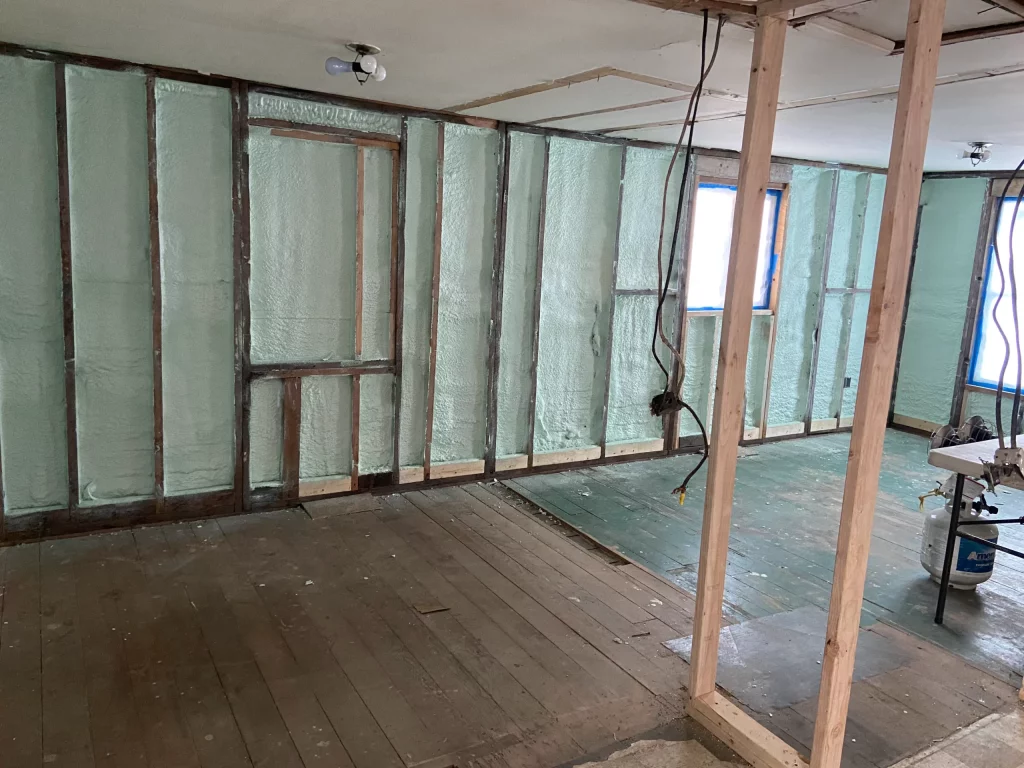
“Spray foam off-gasses dangerous chemicals forever.” Once cured, which happens within 24 to 72 hours depending on thickness and conditions, spray foam is inert and non-toxic. The curing process does produce vapors that require proper ventilation and protective equipment during application, but fully cured foam does not release harmful emissions.
“Closed-cell foam traps roof leaks and hides damage.” This concern has some validity in roofing applications where closed-cell foam is sprayed directly under roof sheathing. If a roof leak develops, the foam can indeed slow the appearance of moisture on the interior side. For this reason, proper roof inspection and maintenance remain essential, and some building professionals prefer open-cell foam in certain roof assemblies to allow leak detection. In wall and crawlspace applications, this is not a practical concern.
“More R-value is always better, so thicker is always worth it.” There is a point of diminishing returns with any insulation material. Beyond a certain thickness, the additional R-value provides progressively smaller improvements in energy performance. Building codes specify minimum required R-values by climate zone, and exceeding those minimums offers decreasing energy savings relative to cost. Our team can help you identify the thickness that balances code compliance, energy performance, and budget.
Choosing the right installation team matters as much as choosing the right material. Here are indicators of a qualified contractor:
Polyseal Insulation provides closed-cell spray foam insulation for homes and commercial buildings throughout the Anchorage and Mat-Su Valley area. Whether you are building new, retrofitting an existing structure, or need crawlspace or attic insulation, our team will evaluate your building envelope and recommend the right approach for Alaska’s demanding climate. We handle residential and commercial insulation projects ranging from $1,500 to $100,000+, and we work with average home sizes of 1,500 to 4,000 square feet.
Reach out to us at (907) 745-7325 or [email protected] to discuss your project. We will walk you through your options and provide a clear, detailed quote.
Request a Quote | Schedule an Assessment
Most closed-cell spray foam cures within 24 hours and is safe for light contact. Full off-gassing and structural curing typically complete within 72 hours, depending on ambient temperature, humidity, and application thickness.
Yes, through a process called drill-and-fill where small holes are drilled through the exterior or interior sheathing and foam is injected into the wall cavities. This is most practical during a remodel or re-siding project when wall cavities are already accessible.
In most occupied spaces, the International Residential Code requires spray foam to be covered with a 1/2-inch gypsum wallboard thermal barrier or equivalent fire-rated material. There are limited exceptions for attics that meet specific access and ignition resistance criteria.
Alaska falls primarily within IECC Climate Zones 7 and 8. The DOE recommends attic insulation of R-49 to R-60 and wall insulation of R-25 to R-30 for these zones. Closed-cell spray foam achieves these targets in less depth than fiberglass or cellulose, making it a practical choice for thinner wall assemblies.
The DOE estimates that proper insulation and air sealing can reduce heating and cooling costs by up to 20%. Closed-cell spray foam’s combined air sealing and high R-value make it one of the most effective single products for reducing energy loss, though actual savings depend on your home’s existing insulation, air leakage levels, and HVAC system.