
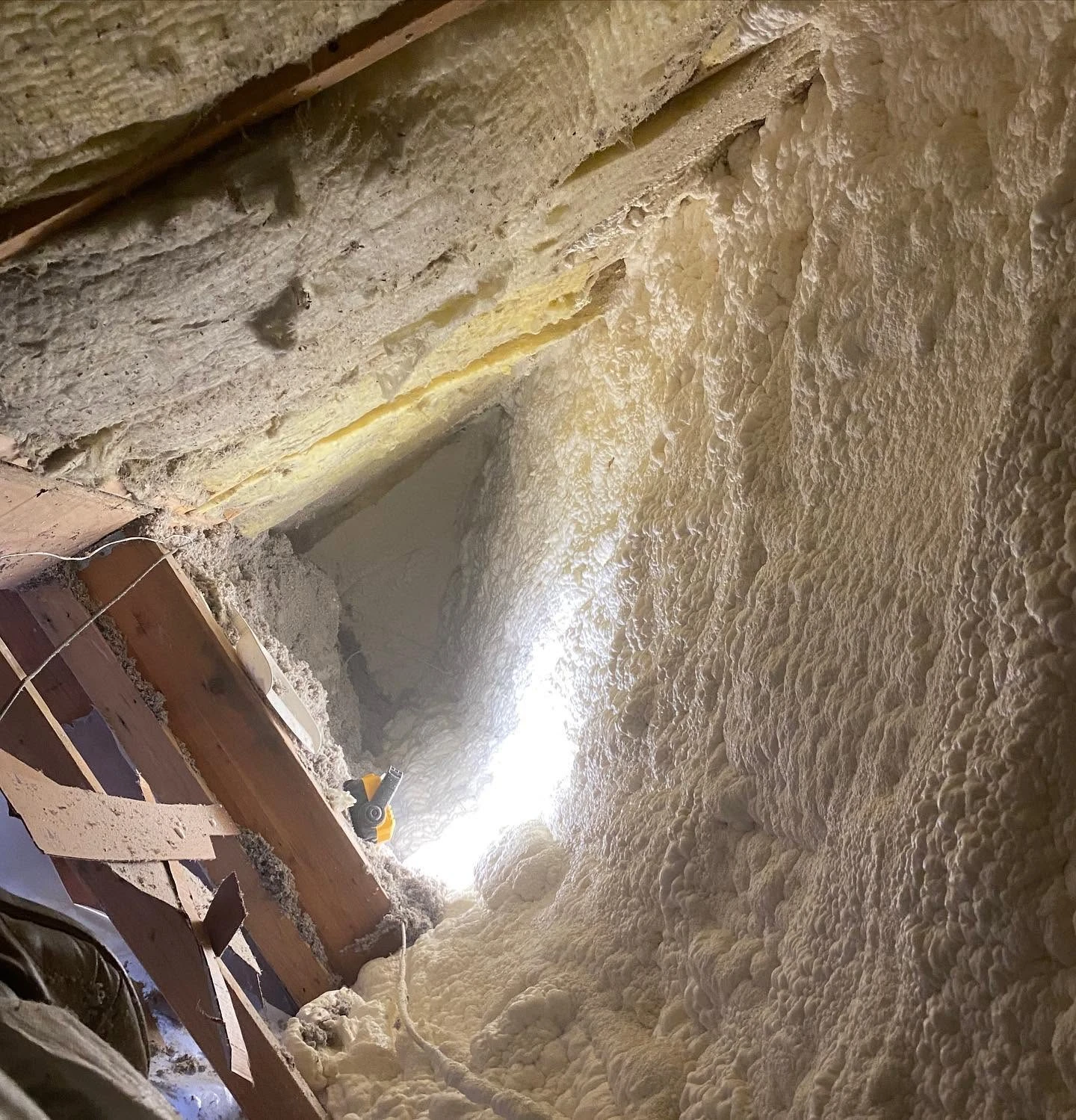
Open-cell spray foam delivers R-3.5 to R-3.8 per inch of thermal resistance, class-leading air sealing at full cavity depth in a single pass, and noticeable sound dampening, making it a practical choice for above-grade wall cavities, attics, and cathedral ceilings in modern residential and commercial construction. Its lower installed material density means it costs less per board foot than closed-cell alternatives, but it also absorbs and holds water, which limits its use in below-grade and flood-prone assemblies, as explained in the Essential Guide to Open-Cell Spray Foam. The right choice between open-cell and closed-cell spray foam depends on climate zone, building assembly location, moisture exposure, and project budget rather than a universal “best” answer.
Open-cell spray polyurethane foam (ocSPF) is a half-pound density material that expands roughly 150 times its original liquid volume during application. According to the U.S. Department of Energy’s Building America program, it delivers a typical aged R-value of approximately R-3.6 per inch, compared to R-6.1 per inch for closed-cell foam DOE Building America – Which Spray Foam Is Right For You?. In a standard 2×6 framed wall cavity (5.5 inches), a full fill of open-cell foam reaches roughly R-20, which meets or exceeds prescriptive code requirements in many climate zones.
The R-value is a measure of thermal resistance, specifically how well a barrier resists conductive heat flow R-value (insulation) – Wikipedia. But R-value alone does not tell the whole story with open-cell foam. Because the material expands to fill every gap, crack, and void in the framing cavity, it eliminates the air leakage pathways that undermine the labeled R-value of batt insulations. Fiberglass and cellulose, by contrast, allow significant convective and air-leakage heat loss that reduces their real-world performance well below laboratory ratings.
Both open-cell and closed-cell spray foams are excellent at air sealing, which is a frequently overlooked but critical aspect of insulated building assemblies. The liquid-to-expanding-foam process fills gaps, cracks, and voids responsible for uncontrolled air leakage. As the DOE Building America guide notes, this air-sealing attribute makes SPF insulation performance superior to typical insulations such as fiberglass or cellulose, which are far less able to block air flow.
Building science research has long established that airtightness is the primary factor in reducing heat transfer through the building envelope. Thermal Insulation reduces unwanted heat loss or gain and can decrease the energy demands of heating and cooling systems, but only when installed correctly within a well-sealed assembly Building insulation – Wikipedia. Open-cell foam delivers both the insulating layer and the air barrier in a single application step.
The DOE Building America guide provides a detailed climate-by-climate assessment of where open-cell spray foam works well and where it does not. Here is a summary of the key findings:
| Application | Climate Zone | Rating | Why |
|---|---|---|---|
| Frame wall cavities | Cold | Preferred | Effective R-20 in full cavity; requires interior vapor retarder |
| Frame wall cavities | Hot-humid | Acceptable | Lower temperature delta; moisture control matters |
| Frame wall cavities | Hot-dry | Preferred | Low moisture loading; forgiving climate |
| Sloped roof rafters | Cold | Acceptable | Good air sealing; requires vapor-retarder paint or covering |
| Sloped roof rafters | Hot-humid | Acceptable | Allow interior drying; no interior vapor retarder |
| Foundations and below grade | All | Not acceptable | Moisture permeable; absorbs water from soil contact |
| Behind brick veneer | All | Not acceptable | Cannot serve as drainage plane; absorbs solar-driven moisture |
| Band joists and mudsills | Cold | Acceptable | Good air sealing; small area justifies cost |
| Band joists and mudsills | Hot-humid | Closed-cell preferred | Moisture risk higher; vapor-impermeable foam safer |
In cold climates, open-cell foam in wall cavities is rated as the preferred application. The full cavity fill provides approximately R-20 of thermal resistance, and the air-impermeable quality eliminates drafts and convective loops within the wall. The critical factor is interior moisture control. High interior relative humidity combined with pressure-driven airflow can cause open-cell foam to absorb moisture, so an interior vapor-retardant paint or primer is recommended, along with a vapor-permeable exterior sheathing to allow outward drying.
Open-cell foam applied directly to the underside of roof decking has become a common approach for cathedral ceilings and unvented attics. It provides full coverage at the roof plane, eliminating air leakage between the living space and attic. In cold climates, a vapor-retarder coating or paint on the exposed foam surface (or on the ceiling finish below it) is needed. The foam’s permeability allows the assembly to dry inward, which can be an advantage when roof leaks occur because the wetting is detectable and the material can dry over time.
The vapor permeability of open-cell spray foam is one of its most defining characteristics. At a typical installed thickness of 5 inches, the material rates 5 to 10 perms, well above the 1.0 perm threshold for a vapor retarder. This means the foam allows water vapor to pass through it, which is beneficial in many wall assemblies because it provides a drying pathway. Building Science Corporation’s vapor barrier research emphasizes that building assemblies should be designed to both keep water out and let water out if it gets in, and vapor-permeable insulations support that second requirement BSD-106: Understanding Vapor Barriers – Building Science Corporation.
However, open-cell foam is not vapor impermeable, and it will also absorb and hold liquid water. The DOE guide notes that the amount of water it can hold varies by product but can reach up to one-third of its volume. This is why it is rated as not acceptable for below-grade foundations, crawlspaces with high moisture exposure, and behind brick veneer where solar-driven moisture can push water into the wall cavity.
Open-cell spray foam delivers meaningful acoustic performance in addition to its thermal function. The DOE Building America testing data shows a 2×4 wood stud wall assembly with open-cell foam achieves a Sound Transmission Class (STC) rating of 23 and a Noise Reduction Coefficient (NRC) of 37. While not a replacement for dedicated acoustic assemblies, this level of performance noticeably reduces airborne sound transmission between rooms and from exterior noise sources. For homeowners building near busy roads or for commercial spaces requiring speech privacy, this dual benefit is a practical advantage.
Understanding the real differences between open-cell and closed-cell spray foam helps builders and homeowners make informed decisions. Both are chemically similar, applied as a two-part liquid spray, but their physical properties diverge sharply.
| Property | Open-Cell (0.5 lb/ft³) | Closed-Cell (2.0 lb/ft³) |
|---|---|---|
| R-value per inch | R-3.6 | R-6.1 |
| Expansion ratio | ~150x | ~35-50x |
| Vapor permeance (5″ thick) | 5-10 perms | Less than 1 perm |
| Water absorption | Holds up to 1/3 volume | Hydrophobic, does not absorb |
| Air permeance | Air-impermeable | Air-impermeable |
| Density | 0.5 lb/ft³ | 2.0 lb/ft³ |
| Compressive strength | Less than 2.0 psi | 22 psi |
| STC (2×4 wall assembly) | 23 | 23 |
| NRC (2×4 wall assembly) | 37 | No data available |
| Application thickness per pass | Up to 10″ (full cavity) | 2″ to 3″ (multiple layers) |
For new homes in cold and mixed climates, open-cell spray foam in wall cavities and cathedral ceilings is a strong choice when paired with proper interior vapor control. It provides the air-tightness that modern energy codes require and delivers acoustic comfort that homeowners notice immediately. In hot-humid climates, closed-cell foam may be the safer choice for wall assemblies because it provides redundant moisture control, while open-cell foam can still work well in vented attics and ceilings.
Open-cell spray foam is effective for retrofitting existing wall cavities where the framing is exposed, such as during a gut renovation or addition. Its ability to fill full cavities in a single pass makes it faster to install than closed-cell, which requires multiple passes and layers. For existing homes needing crawlspace encapsulation, closed-cell is the appropriate choice regardless of budget, because open-cell foam cannot handle the moisture environment of a below-grade space.
In commercial construction, open-cell spray foam works well in above-grade walls, office partitions where sound control matters, and ceiling assemblies. For large commercial projects, the per-board-foot material savings of open-cell foam can be meaningful on high-volume cavity-fill applications.
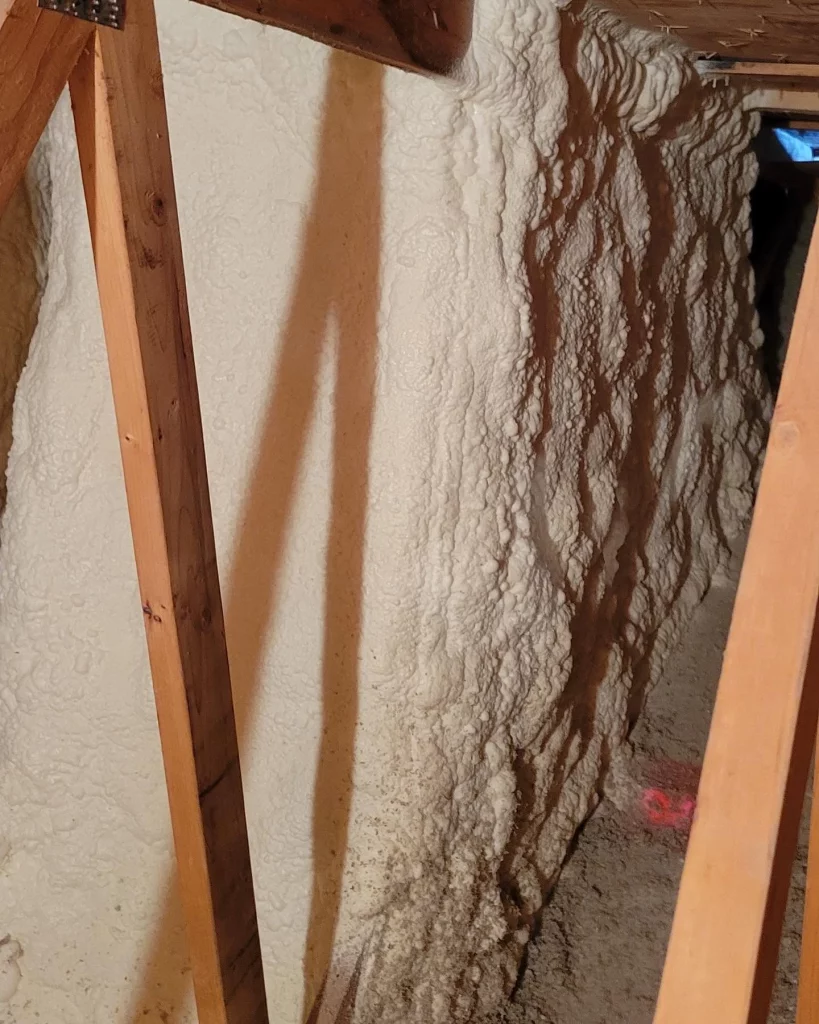
Polyseal Insulation serves the Anchorage/Matsu Valley area with professional spray foam installation for residential and commercial projects throughout Alaska. Our team evaluates every building assembly individually, recommending the right foam type and thickness for your climate, structure, and budget. Whether you are building new, remodeling, or retrofitting, we bring the expertise needed to get the details right from design through installation.
Request a Quote | Schedule an Insulation Assessment
Call us at (907) 745-7325 or email [email protected] to discuss your project.
Open-cell foam is not recommended for crawlspaces or any below-grade application because it absorbs and holds liquid water. Closed-cell spray foam is the appropriate choice for these moisture-prone environments.
In cold climates, an interior vapor-retardant paint or primer is recommended on the finished surface. In hot-humid climates, interior vapor retarders should be avoided to allow the assembly to dry inward. The requirement depends on your climate zone and assembly type.
Open-cell foam provides noticeably better acoustic performance than fiberglass batts. A 2×4 stud wall with open-cell foam achieves an STC of 23 and NRC of 37, which reduces airborne sound transmission between rooms.
Open-cell foam is rated as a preferred application for frame wall cavities in cold climates when paired with proper interior vapor control. It delivers full-cavity air sealing and approximately R-20 in a 5.5-inch wall cavity.
Open-cell foam cannot function as a drainage plane and absorbs moisture pushed inward by solar-driven vapor from wet brick. Closed-cell foam is required behind brick veneer to serve as both an air barrier and drainage plane.