

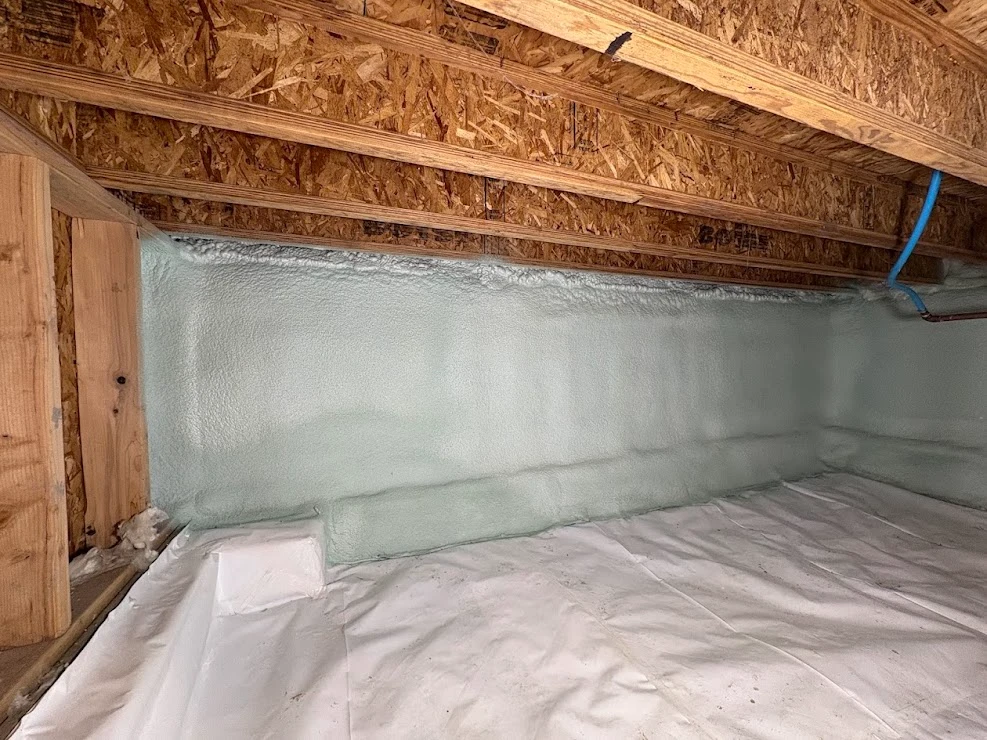
Spray foam insulation is a practical choice for improving crawl space floor coverage in Fishhook, AK because it combines high R-value per inch, air sealing, and vapor resistance in a single application, which is exactly what a crawl space floor needs in a subarctic climate. Fishhook sits in the Matanuska-Susitna Borough at roughly 61.7 degrees north latitude, in a subarctic climate zone where Southcentral winters are long, cold, and windy, and snow is a regular feature of the season. In those conditions, an uninsulated or under-insulated crawl space pulls heat out of your floors, chills plumbing, and feeds cold air into the house through stack effect. Closed-cell spray foam adheres directly to the subfloor and rim joist, fills irregular joist bays completely, and does not sag or leave gaps the way loose batts often do in a cramped space. For anyone using a spray foam insulation guide to compare crawl space applications, the right approach still depends on your home: a sealed, encapsulated crawl space insulated at the walls suits homes with ducts and equipment below the floor, while foam applied to the floor system suits vented or low-clearance spaces.This guide walks through how each strategy works, what it costs in our Anchorage and Mat-Su Valley service area, and how to choose the right one for your property.
A crawl space is an unfinished, narrow space between the ground and the first floor, and in cold regions it becomes one of the biggest gaps in the building envelope. Here is what happens in a typical Fishhook, AK, winter:
Fishhook’s setting amplifies all of this. The community is spread across about 65 square miles of lakes and the Little Susitna River corridor, homes here are often on larger rural lots with mid-sized or older housing stock, and winter winds funnel through the Mat-Su valley. Southcentral Alaska averages roughly 16 inches of precipitation and around 75 inches of snow per year, so spring melt under a floor is a real moisture event, not a theoretical one.
Spray polyurethane foam is applied as a liquid and expands up to 30 to 60 times its volume, which lets it reach places cut-to-fit boards cannot (Wikipedia, Spray foam). For crawl space floor coverage, medium-density closed-cell foam is the practical pick for three reasons:
That last point deserves emphasis. Building science research consistently identifies air leakage as a major driver of home energy loss, and foam’s custom airtight envelope is its most important attribute. R-value alone does not describe that benefit, which is why a thinner foam application can outperform a thicker batt in real-world conditions.
| Strategy | Best For | Key Tactics | Expected Outcomes | Limitations |
|---|---|---|---|---|
| Closed-cell spray foam at floor system and rim joist | Vented or low-clearance crawl spaces with irregular framing | Foam applied between joists and at the band joist, sealing penetrations | Warm floors, sealed air leaks, vapor control in one step | Higher material cost per R than batts; requires professional application |
| Sealed (encapsulated) crawl space with wall insulation | Homes with ducts, plumbing, or equipment in the crawl space | Ground vapor retarder, sealed vents, insulated walls, conditioned air supply | Warmest assembly; protects pipes and equipment; per DOE research, significantly lower conditioning energy | More invasive; code requires a drying mechanism such as conditioned air supply |
| Fiberglass batts between joists | Short-term budget fixes on open, accessible layouts | Batts friction-fit between joists | Lowest upfront spend | Does not stop air movement; sags, gaps, and pest nesting undo performance |
| Rigid foam board at walls | Open, clean-geometry crawl spaces with good standing room | Board mechanically fastened to walls, joints sealed with canned foam | Consistent wall performance, low vapor permeance | Hard to seal irregular gaps; labor-intensive in tight quarters |
Sealed crawl spaces and foam air sealing are complementary, not competing. The PNNL Building America Solution Center, a Department of Energy program, notes that spray foam can be used at rim joists and floors above unconditioned space to insulate and air seal at the same time, and that unvented insulated crawl spaces keep floors warmer and help protect HVAC equipment and plumbing from freezing in cold climates.
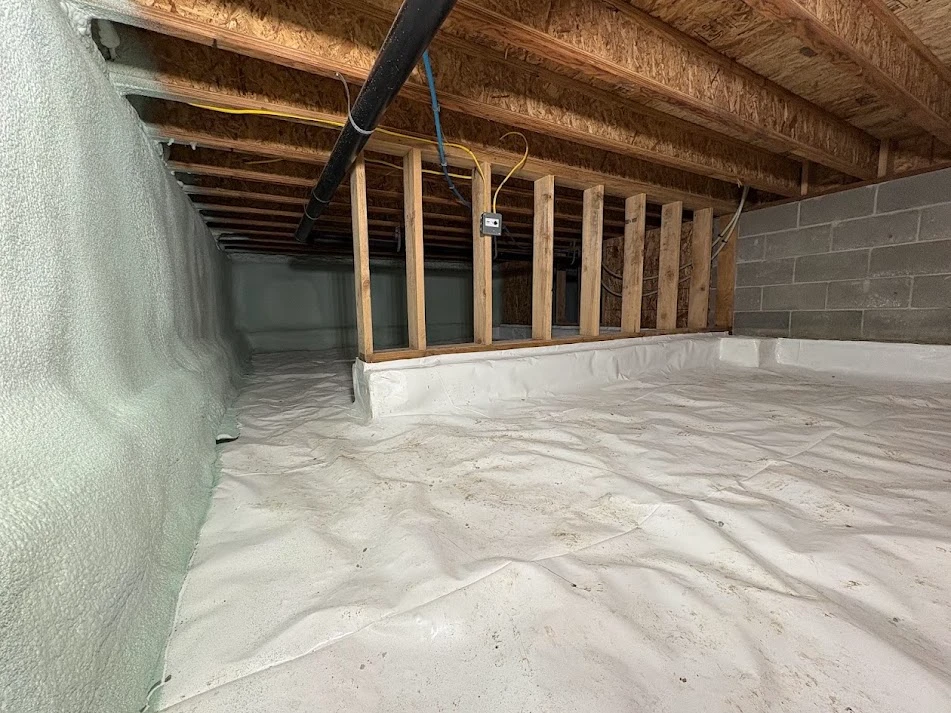
We serve Spray Foam Insulation in Fishhook, AK and the broader Matanuska-Susitna Valley, and our project records show the real-world shape of this work. Typical residential homes in our market run 1,500 to 4,000 square feet, crawl spaces are one of our most requested project types alongside commercial buildings, walls, and new construction, and most homeowners ask us three questions before buying: open cell versus closed cell, timeline, and energy savings.
| Project Detail | Typical Range in Our Market |
|---|---|
| Crawlspace insulation project, low | $1,500 |
| Crawlspace insulation project, average | $5,000 |
| Crawlspace insulation project, high (large or complex) | $20,000 |
| Smallest job we take | $1,500 |
| Average home size we work on | 1,500 to 4,000 sq ft |
Three factors move a quote along that range more than anything else:
The takeaway: a modest, accessible crawl space with clean joists sits near the low end, while a tight, cluttered space full of failing batts under a large footprint climbs toward the top.
| Property Scenario in Fishhook | Recommended Approach | Key Notes |
|---|---|---|
| Older home with cold floors and vented crawl space | Closed-cell foam at floor system and rim joist | Fastest path to warm floors without reworking the whole foundation |
| Home with furnace, ducts, or water lines in the crawl space | Sealed, encapsulated crawl space with insulated walls | Brings equipment inside the thermal envelope and cuts freeze risk |
| New construction in the Mat-Su Borough | Closed-cell foam integrated into the framing plan | Easiest and cheapest to do before finishes go in |
| Seasonal cabin or part-time residence | Foam at the floor system plus sealed ground vapor retarder | Protects plumbing during unoccupied stretches |
| Crawl space with a history of standing water or dampness | Moisture management first, then foam | Sealants and foam go in only after water and soil moisture issues are addressed |
Our process is straightforward and built around the conditions we see across Fishhook and the valley:
Our team at Polyseal Insulation specializes in closed-cell and open-cell spray foam for crawl spaces, floors, walls, attics, and commercial buildings across Fishhook, Palmer, Wasilla, and the Anchorage and Mat-Su Valley area. We will evaluate your crawl space, explain the options in plain language, and give you a clear, itemized quote based on the actual conditions under your home. Call us at (907) 745-7325 or email [email protected] to get started.
Request a Quote | Schedule a Crawl Space Assessment
Do not wait for the first hard freeze to find out what your floors are losing. Our crew is ready to help you seal, insulate, and protect the space under your home before winter settles in.
Is closed-cell spray foam safe to use inside my crawl space?
Yes, once it cures fully the foam is inert. During application, trained installers use respiratory and skin protection, and the space needs proper ventilation and cure time before reentry.
Can I insulate just the floor joists instead of the whole crawl space?
Yes, that is the standard approach for vented or low-clearance spaces, and it delivers warm floors and air sealing at the subfloor. If ducts or plumbing live in the crawl space, insulating the walls and sealing the space may serve you better.
How long does a typical crawlspace insulation project take?
Most residential crawl spaces in our area are completed in a single day to a couple of days. Access difficulty, crawl height, and the need to remove old insulation extend the schedule.
Will spray foam help with moisture under my home?
Closed-cell foam acts as a vapor barrier at the assembly it covers, which addresses condensation on cold surfaces. It does not fix standing water or groundwater problems, so those get corrected first.
Do you work in Fishhook specifically?
Yes, Fishhook is part of our primary service area across the Anchorage and Matanuska-Susitna Valley region, and travel distance is one factor we factor into every quote.